Glass Bead Game
The Glass Bead GameThe Glass Bead Game is the supreme symbolic art of Castalia: a rigorously governed language through which players place the sciences, arts, and other forms of human knowledge in relation. It promises a vision of intellectual unity, but the novel gives that promise a double edge. The Game can become a contemplative discipline and a public rite; it can also become an alluring specialization, so complete in its own terms that it risks isolating its players from life beyond it.
A universal language under rules
The Game’s grammar draws especially on mathematics and music, using signs and formulas to express relations among nearly all scholarly disciplines. Its imagined instrument is an immense organ whose manuals, pedals, and stops encompass the intellectual cosmos: in theory, it can reproduce the entire intellectual content of the universe. Yet this range does not mean that the Game is an unregulated accumulation of ideas. Its basic structure is fixed, and adding new material or revising its rules is subject to strict institutional control. Within those limits, however, the combinations available to players are effectively inexhaustible. Even when two players happen to choose the same small group of themes, their games may take different courses and assume different forms because of differences in their minds, character, mood, and virtuosity.
The narrator therefore refuses to reduce the Game to a set of easily transmitted instructions. Its rules are learned through a prescribed course lasting years, and the book’s popular introduction does not claim to provide a full theory or history. The distinction matters: the Game is not simply a system that can be mastered by reading about it. It depends on prolonged practice in a shared intellectual culture, and on a discipline of interpretation that its technical vocabulary alone cannot supply.
Its history is presented less as the invention of a single person than as the emergence of an enduring intellectual aspiration: to bring the diverse pursuits of the mind into a common order. The Swiss mathematician and musicologist remembered as Lusor Basiliensis gave the Game a decisive advance by devising a symbolic language in which mathematics and music could be brought to a common denominator, even allowing astronomical and musical formulas to be combined. His work answered a wider demand among scholars for synthesis and for a language that could communicate complex ideas across specialized disciplines. The result was foundational, not final: the Game continued to develop beyond his achievement.
From intellectual play to contemplation
In its earlier form, a Game arranged, grouped, and set in relation concentrated ideas from different fields. It could be a virtuoso passage through intellectual and aesthetic traditions, but speed and memory alone did not guarantee understanding. Players with extraordinary recall could overwhelm others with rapid displays of learning, even when their feats lacked other virtues. As a corrective, contemplation became central. After a symbol was introduced, players were expected to meditate silently on its content, origin, and meaning, summoning its full significance rather than merely recognizing it. The change made the Game less a display of how many connections could be produced than a practice of inward attention to what those connections meant.
Its characteristic form is musical. A Game may begin with an astronomical configuration, a theme from a Bach fugue, or a sentence from Leibniz or the Upanishads. Players can elaborate the initial motif or enrich it through related concepts, much as musical themes are stated, varied, and developed. Beginners learn to establish parallels, such as one between a piece of classical music and the formula for a law of nature; experts and Masters can weave the initial theme into extensive combinations. One historical school deliberately set opposing ideas—law and freedom, for example, or the individual and the community—side by side, developed them in counterpoint, and sought to bring them into a synthesis. The aim was to treat both sides with equality and impartiality, not simply to make one defeat the other.
This ideal also shapes what a successful conclusion can be. Discordant, negative, or skeptical endings are generally unpopular and have at times been forbidden. At the height of its meaning for its practitioners, the Game is an attempt to move beyond the multiplicity of ideas toward perfection, pure being, and a fullness of reality. Players use the language of realization to describe its movement from potentiality to actuality, or from becoming to being. The structure of the Game thus makes synthesis not just a technique but a spiritual aspiration: a patterned approach to unity beyond the separate signs and disciplines.
Public rite and institutional guardianship
For much of its history the Game was a private exercise, played alone or in groups. Successful games might be written down and circulated for admiration or criticism, but they were not yet public ceremonies. It later acquired a ceremonial role. Public Games, led by senior Masters subordinate to the national Master of the Game, drew invited listeners and audiences following across the world. Some lasted days or weeks. The players and guests then submitted to a strictly regulated, selfless concentration, including rules governing how long they could sleep. The ceremony made participation itself a discipline: the Game was not only performed for an audience but temporarily ordered the lives of those gathered around it.
Its annual solemn Game became a major festival in Castalia. Even when the older Games lasting weeks and attended by representatives from around the world had passed into history, the spring gathering—with a solemn performance usually lasting ten days to two weeks—remained a defining event of the year. It brought together the Province’s sometimes competing intellectual tendencies in a symbolic act of harmony, setting aside the ambitions of separate disciplines and recalling their shared inheritance. For believers it could have the force of sacramental consecration; for unbelievers it could serve as a substitute for religion, and for both as an experience of beauty. Its function is consequently both cultural and religious, though the Game itself does not establish a theology.
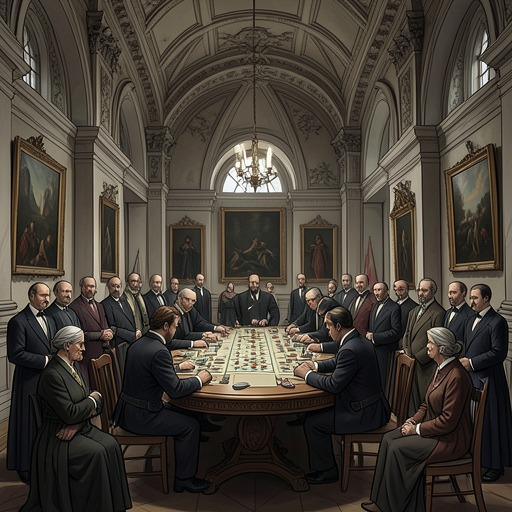
That scale and authority require governance. National Game Commissions and their heads supervise players and schools, conduct official Games, and oversee the further development of the discipline. The World Commission of the Magisters decides whether new symbols and formulas enter the established repertoire, whether rules are modified, and whether further fields are brought within the Game’s scope. Each national Commission maintains an Archive recording accepted symbols and interpretations; its accumulated entries have long since surpassed the number of ancient Chinese ideographs. These bodies act as guardians of a shared symbolic vocabulary. Their control preserves the conditions of mutual understanding, while also making clear that the supposedly universal language has institutions that decide what it may include.
The Game’s relation to religion reveals another tension within that institutional world. Christian theological language—including elements of the Creed, biblical passages, the Church Fathers, and the Latin Mass—can enter the Game alongside geometry or music. To genuine players, the Game may be virtually equivalent to worship, although it deliberately avoids developing a theology of its own. This resemblance has drawn both attraction and suspicion. The Roman Church and the Game have depended on one another enough to avoid decisive confrontation, despite recurrent disagreements. The Church’s attitude has vacillated between benevolence and hostility, and Pope Pius XV even contemplated putting the Game on trial, which might have led to Catholics being forbidden to play. He died before carrying out the plan. The episode shows that the Game’s spiritual character is not a settled claim of authority: it remains a point of possible conflict between Castalian practice and organized religion.
Unity, performance, and the limits of abstraction
Castalia presents the Game as the most perfect expression of the unity of human culture. The Game players’ task, as Joseph Knecht describes it, is to keep disciplines from treating themselves as self-sufficient and to maintain their relations with one another. The Game is meant to show the necessity and attraction of universality, not to impose itself as a compulsory school subject. Its case must be made through the freshness and persuasiveness of its practice and by incorporating new achievements and problems from the scholarly fields. The institutional elite is therefore not only a source of officials: it continues to train and refine players who may never occupy official positions. The art has no final stage of development for those who serve it throughout their lives.
But universality has limits when it becomes an abstraction from the things it represents. Knecht’s musical training offers a concrete counterweight to the Game’s power to distill. He argues that music cannot be understood solely through the intellectual patterns extracted from it: its meaning also resides in breath, rhythm, timbre, the blending of voices, and the physical act of making sound. His own schooling in practical musicianship delayed his formal study of the Game, because he wanted to know music through hearing and performance as well as through its abstract relations. This distinction clarifies the Game’s achievement and its risk. It can connect musical structures with other kinds of knowledge, but a symbolic account of music cannot replace the sensuous experience from which music takes much of its life.
The same problem appears in the difference between a public symbol and a private association. In a recollection of an early experience, Knecht describes how the scent of a cut elder twig became associated for him with the opening chords of Schubert’s spring song. The connection was immediate and enduring for him, and he could explain it to others. But explanation could not make the same sensory link an effective symbol for anyone else. The distinction throws light on what the Game must achieve: unlike a personal association, its signs must be shared, learned, and usable by a community. Its universality rests on rules and collective training, not on the assumption that one person’s inner experience can simply be transmitted to another.
The allure and danger of the Game
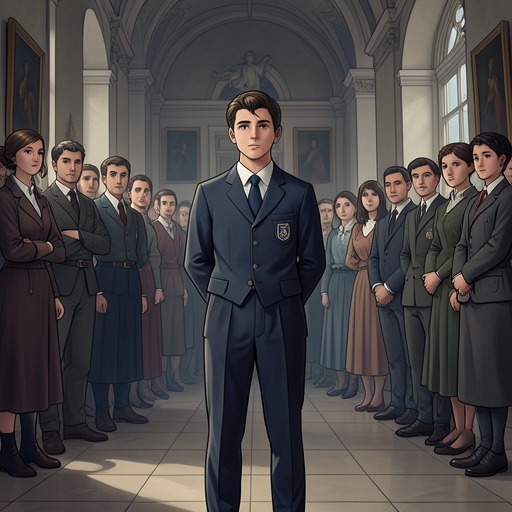
Knecht’s own relation to the Glass Bead Game is marked by attraction and resistance. He recognizes it as the most precious and distinctive product of Castalia, yet for years he distrusts its spell. He senses that it demands the whole person from anyone who yields to it, and worries that its cultivated virtuosity may be a specialized spirit, raised into proud solitude and cut off from humanity and the larger life. His eventual decision to serve it comes not from failing to see this danger but from a choice to give himself to what he regards as the highest master. That choice is powerful precisely because its cost remains visible: the Game can be both the fullest embodiment of cultural synthesis and an institution vulnerable to enclosure within its own excellence.
The poems associated with the Game preserve this double image. One pictures a solitary last player with colored beads in hand, head bent over a devastated landscape. Another describes the boundlessness and storm of existence being given form, the telling of beads as service to the whole, and the player held within the orbit of a cosmic soul. The contrast is not simply between mastery and failure. In one image, the Game’s implements remain with a lone figure after the world around him has fallen away; in the other, disciplined play makes the chaos of existence inhabitable by placing it in a shared pattern. The Game’s central promise—and its enduring question—is whether a perfected symbolic order can keep serving the living whole, rather than becoming a world apart from it.